
Online Public Engagement Tool
for Policy Development
Dementia Screening Policy
Role
Content Lead, User Researcher, Product Manager
When
6/2019 - 2/2020
WHY
To develop a well-thought-out policy recommendation to improve the dementia preventive system in Thailand, it’s very important to talk to the public so they can express the real demand. Talking about ‘public’, it consists of many groups of people, e.g. different age groups, various living conditions.
The hypothesis of this project was that people would have different needs for the dementia screening model. The one-size-fits-all policy would not work. Therefore, we need a new tool that people will love to interact with and be willing to voice their opinions.

HOW

I and the team at RISE IMPACT proposed to the Foundation of Thai Gerontology Research and Development Institute, to develop a new policy development tool that can gain insights from the public on what they actually want - given that they must be educated enough to give an opinion - to eventually allow us to develop a more insightful policy.
The so-called ‘public engagement tool’ was designed to work on mobile; Facebook and LINE as they are the major accessible platform for Thai people.
The Public Engagement Tool was made into 3 sections with 3 purposes;
1. to educate people about dementia by making it fun and interactive
2. to immerse the audience with the mild-cognitive impairment experience
3. to understand what people want e.g. which dementia screening model they want, which service provider at the top of their minds
We aim at finding the answers of 4 questions.

Prior to launching, we created user stories, used Figma to build demo, test, get feedback from stakeholders, and iterate until the sample users had a comfortable experience engaging with the tool.
OUTCOME

-
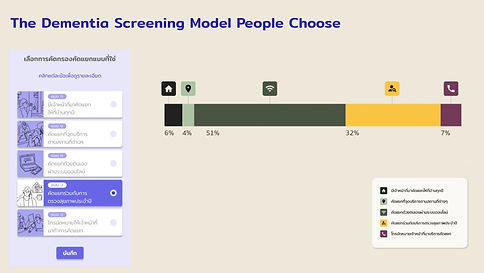
Over 850 people from 70 provinces in Thailand participated in the public engagement tool within 2 weeks. The quantitative data made a policy recommendation for dementia screening more evidential and convincing.
-
The public engagement tool was distributed organically without any paid ad, this reflects that many people are interested to participate in the policy process. The public engagement tool itself has proven its value to help policymakers develop a more comprehensive policy.