
Improving Dementia Screening System
- making a Policy Recommendation
Role
When
Strategic designer & facilitator, Content Lead
8/2020 - 5/2021
WHY
Dementia is found in 6-10% of the aging population in Thailand. The number is accelerating as Thailand is becoming super-aged society in 2030.
Many people seems to think that dementia normally happens as we get old - which is not true. So we only notice that a person got dementia when the symptom is severe - which is too late to treat. People with dementia are mostly dependent to the family and will live for another 10-20 years. Interestingly, 1/3 of the carers are also found depressed due to the overwhelmed and continuous support they must provide to the patient.
My client, the Foundation of Thai Gerontology Research and Development Institute, wanted to develop a policy recommendation to tackle the challenge.


HOW
I came up with an iterative design process to develop policy recommendation for the dementia challenge. Due to Covid-19, the majority of the process was done virtually.
Listen to the systems
Dementia was not my expertise in the first place. So I set up 1:1 interviews with stakeholders and conducted group interviews with local health service providers to gain insights of the existing systems thoroughly.
Identify gap and the
leverage point
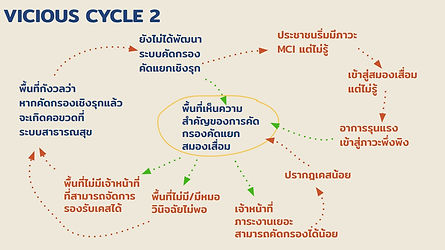
Mapped the stakeholders and visualized dementia (patient) journey. Identified leverage point - the critical challenge that needs to be addressed to improve the systems significantly.
Conduct 3 policy dialogues
with stakeholders
Designed the process in policy dialogues to gain diverse perspectives, validate assumptions, and align common grounds among stakeholders.
Explore ideas and possibilities with public
Designed a so-called ‘public engagement tool’ which is educational and interactive yet collecting demand for dementia screening from the users. Read more
Synthesize & make a policy recommendation
Analyzed all information and synthesized into the strategy for dementia policy.
OUTCOME
-
It was a wicked problem. Now the problem is visualized and clarified throughout the process. So it helped people understand the bottlenecks and identify the leverage points more easily.
-
Stakeholders found a common ground in defining dementia screening targets and goals -to screen people with Mild Cognitive Impairment (MCI) which is a prior stage of dementia. People with MCI can adjust their behaviors to prevent dementia. However, prior to this process, health service providers in most areas didn't want to provide dementia screening due to their limitations.
-
Dementia screening models were eventually designed to match everyone’s contexts based on data.
-
The policy recommendation is concluded and will be proposed to the National Research Council of Thailand (NRCT).
-
The key policy champions and enablers were already involved in the process to ensure a high chance of policy implementation.


_JPG.jpg)